Updated March 31, 2026
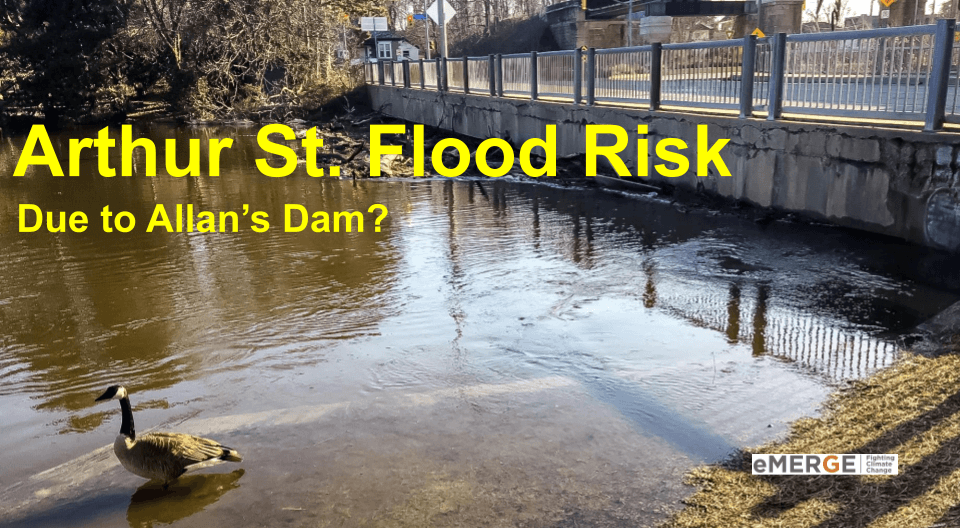
Upstream of Allan’s Dam after 59.5 mm rainfall April 2-3, 2025
eMERGE Guelph Sustainability is raising concerns about the City’s decision to retain Allan’s Dam and what that could mean for flood risk and municipal liability.
What eMERGE has done
eMERGE is challenging the City’s decision to the Minister of the Environment to order a rigorous Environmental Assessment under Section 16 of the EA Act. A response is still pending and usually takes months.
In addition, eMERGE is calling on Guelph City Council to:
- Commission an independent flood-risk review
- Place that review on the public record
- Clearly assess the legal and financial implications of retaining Allan’s Dam
________________________
What you can do
Register for the Online Webinar
Arthur St. Flood Risk – Due to Allan’s Dam?
7:00 pm Wednesday April 8
________________________
What Residents Should Know About Allan’s Dam and Upstream Flood Risk
This issue affects real homes and real families in our community.
Approximately 80 homes and over 200 residents are subject to increased risk of flood damage due to the presence of Allan’s dam. These properties are located on Arthur Street North backing onto the Speed River and also some homes on the other side of the street.
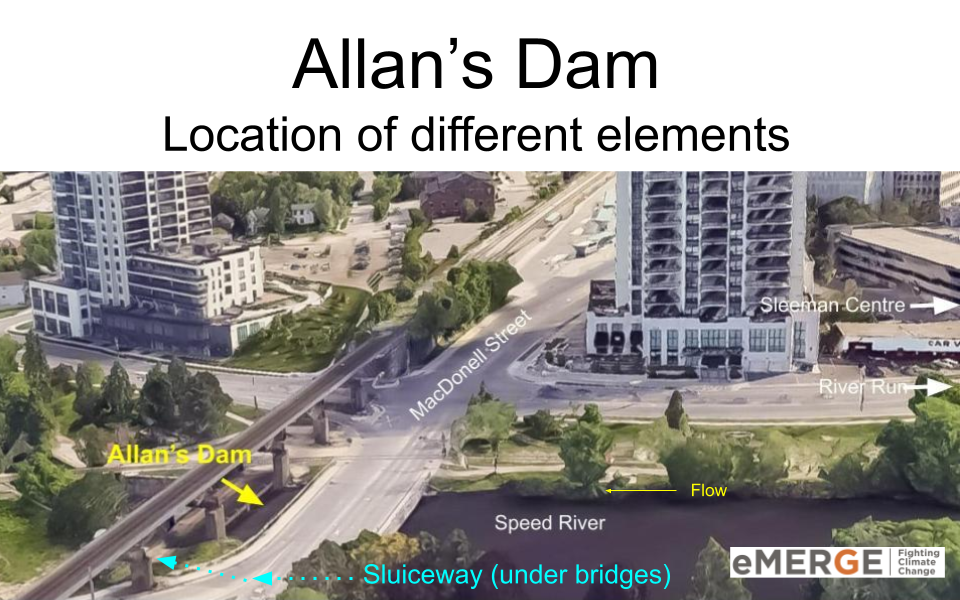
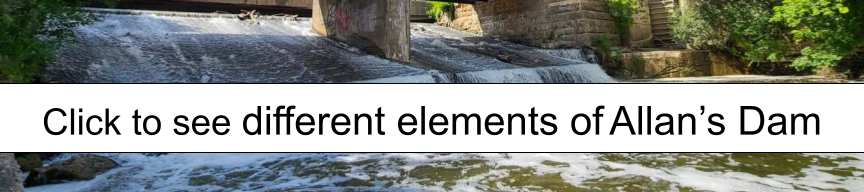
Click photo for views of the dam
In April of 2025, several of these properties experienced backyard flooding. According to floodplain mapping from the Grand River Conservation Authority (GRCA), in a major flood event some of these homes could be completely surrounded by water. The flood criteria used for this analysis is based on historic rainfall events.
With climate change increasing, the frequency and severity of extreme weather events and flood risk is no longer theoretical. It is growing.
What Was Studied by the City — and What Wasn’t?
As part of the City’s Environmental Assessment (EA) process for the Macdonell and Allan’s Structures project, water flow (hydraulic) analysis was conducted. However, this focused primarily on downstream impacts, including effects on the Macdonell Street bridge and the historic (no longer used) Allan’s bridge.
Upstream flood risks to homes on Arthur street received no detailed evaluation.
On October 28, 2025, the night Council made their decision to retain Allan’s Dam (read our detailed submission to the City here), a cost estimate for an upstream hydraulic study was presented but dismissed as too expensive and time-consuming. As a result, Council proceeded without a comprehensive study of upstream flood impacts.
This means the public does not have a complete picture of how retaining or removing the dam could affect upstream flooding.
Why Operational Risk Matters
Allan’s Dam relies on a sluiceway gate system that is meant to manage water levels during flood events. This channel flows underneath the bridges on the left side of the river – when looking downstream. In flood situations, if that gate fails to open, malfunctions, or cannot be operated quickly enough during a major storm, upstream flooding could be even worse.
Infrastructure, loke the sluiceway gate, that doesn’t function perfectly under extreme conditions carries inherent risk. Understanding that risk is essential for responsible decision-making.
Why Liability Is a Public Issue
If significant flooding were to occur – stressing families and damaging homes and property – could the City be scrutinized over whether they:
- Identified foreseeable risks?
- Evaluated reasonable alternatives?
- Exercised due diligence?
Failing to assess known upstream flood risks and the potential positive impacts of removing the dam could potentially expose the City to legal and financial consequences. Those consequences ultimately affect families living in the affected area and all taxpayers.
An independent expert opinion would help ensure that decisions are made with a full understanding of both risks and consequences.
Why This Matters
This is not simply a question about a dam structure. It is about:
- The health and safety of upstream residents
- Responsible risk management
- Financial stewardship
- Transparency in public decision-making
Residents deserve confidence that foreseeable flood risks have been fully assessed before long-term infrastructure decisions are finalized.
Climate Change Benefits of Dam Removal
Climate Adaptation and Resilience Benefits
- Increased Flood Safety:
All dams backup river flows up to a point where they raise the water level upstream. When the area receives excessive rain, the possibility of flooding increases significantly. Based on GRCA potential flood mapping, many homes on Arthur Street North are susceptible to being completely surrounded by water.
Many aging dams were not built to withstand the increased frequency and intensity of extreme weather events like floods driven by climate change. Removing these unsafe dams eliminates the risk of catastrophic failure and potential loss of life and property downstream. Restoring connectivity to floodplains also gives rivers room to accommodate floodwaters naturally.
At issue: The City of Guelph has not evaluated the impact removing the dam would have on reducing the flood risk
Restored Ecosystem Resilience and Biodiversity:
Dams lose vast amounts of water to evaporation, a problem that worsens as temperatures rise. Native species then have a harder time adapting to these changes. Meanwhile, invasive species begin to take hold potentially reducing or eliminating parts of the natural ecosystem.
Dam removal restores the natural flow, temperature, and sediment transport of rivers, which is essential for healthy fish populations and other aquatic life. This enhanced biodiversity and ecosystem health makes the entire river system more resilient to climate stressors like heat waves and droughts.
Cooling Effect: Free-flowing rivers provide a natural cooling effect to surrounding urban areas and local communities, helping to mitigate heat stress during heat waves.
Climate Mitigation Benefits
Reduced Methane Emissions: Dams are a major source of methane (CH), a potent greenhouse gas. CH impacts climate change 80 times more than carbon dioxide (CO2). The stagnant water and accumulating organic matter behind dams create ideal conditions for the anaerobic decomposition that produces methane. Removing dams eliminates these “methane hotspots” and allows rivers to become free-flowing, thereby reducing or eliminating this source of emissions.
Restored Carbon Sinks: Dam removal allows previously flooded land to regenerate native vegetation, such as forests and wetlands, which act as natural carbon sinks, actively drawing CO from the atmosphere.
________________________
What you can do
Register for the Online Webinar
Arthur St. Flood Risk – Due to Allan’s Dam?
7:00 pm Wednesday April 8
________________________
City of Guelph Background
City of Guelph background material on the Environmental Assessment: Macdonell and Allan’s Structures Municipal Class